
In programming, a closure is a function that has access to variables from its outer (enclosing) scope, even
after the outer function has finished executing. In other words, a closure allows a function to "close over"
and remember the environment in which it was created. This enables the function to access variables from the
outer scope, even if those variables are no longer in scope.
Here's a simple example in JavaScript:
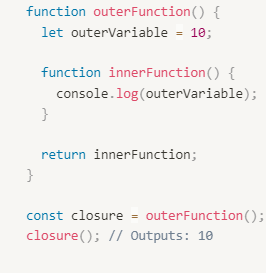
In this example, innerFunction is a closure because it retains access to the outerVariable even after outerFunction has finished executing. When closure is invoked, it still has access to outerVariable and can print its value.
You can watch this video and analyze to understand closures better within 1 minute.
Benefits of using closures:
Here are code samples illustrating each of the benefits mentioned:
Data Encapsulation:
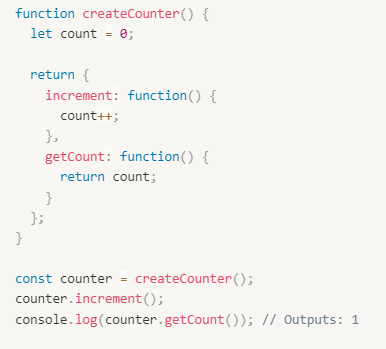
In this example, createCounter returns an object with two methods (increment and getCount). These methods have access to the count variable, which is encapsulated within the closure.
Function Factory:
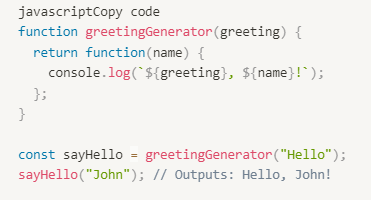
Here, greetingGenerator is a factory function that returns a new function (sayHello). The returned function retains access to the greeting variable from the outer scope.
Maintaining State:
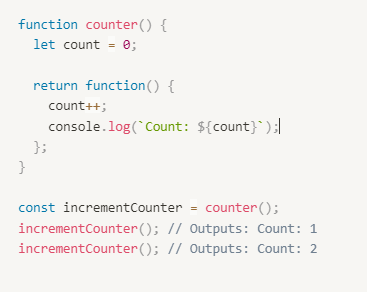
In this example, the counter function returns a closure that maintains the state of the count variable across multiple calls to the returned function.
Callback Functions:
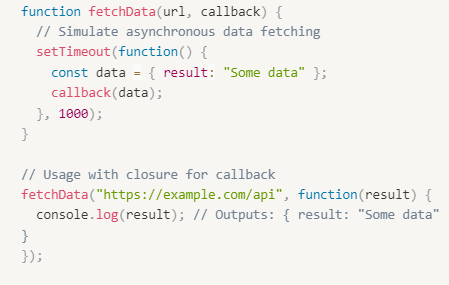
In this scenario, the callback function passed to fetchData retains access to variables in
its
outer scope, allowing it to handle the fetched data in a specific context.
These examples demonstrate how closures can be used to achieve different benefits in terms of data
encapsulation, creating function factories, maintaining state, and using callback functions.